Gordon supplies a strong health layer. A real garrison still needs the right lead, the right first-slot joiners and more than one defensive effect.
Four Gordons can make a Gen 4 garrison easier to organize, but they do not create a complete defense. Gordon covers one layer; Alcar's readiness, the first hero in each reinforcement and the 60:40 formation all solve different parts of the fight.
Four Gordons is easy to call, easy to remember and much better than four random heroes. That does not make it the finish line. Gordon solves squad health. A garrison can still be weak because the wrong hero is leading, the joining heroes are in the wrong slot, or every active skill is pushing the same defensive category.
Do not ask whether Gordon is good. Ask which part of the garrison Gordon is supposed to fix, and what the other active slots still need.
Separate the garrison lead from the rally joiners
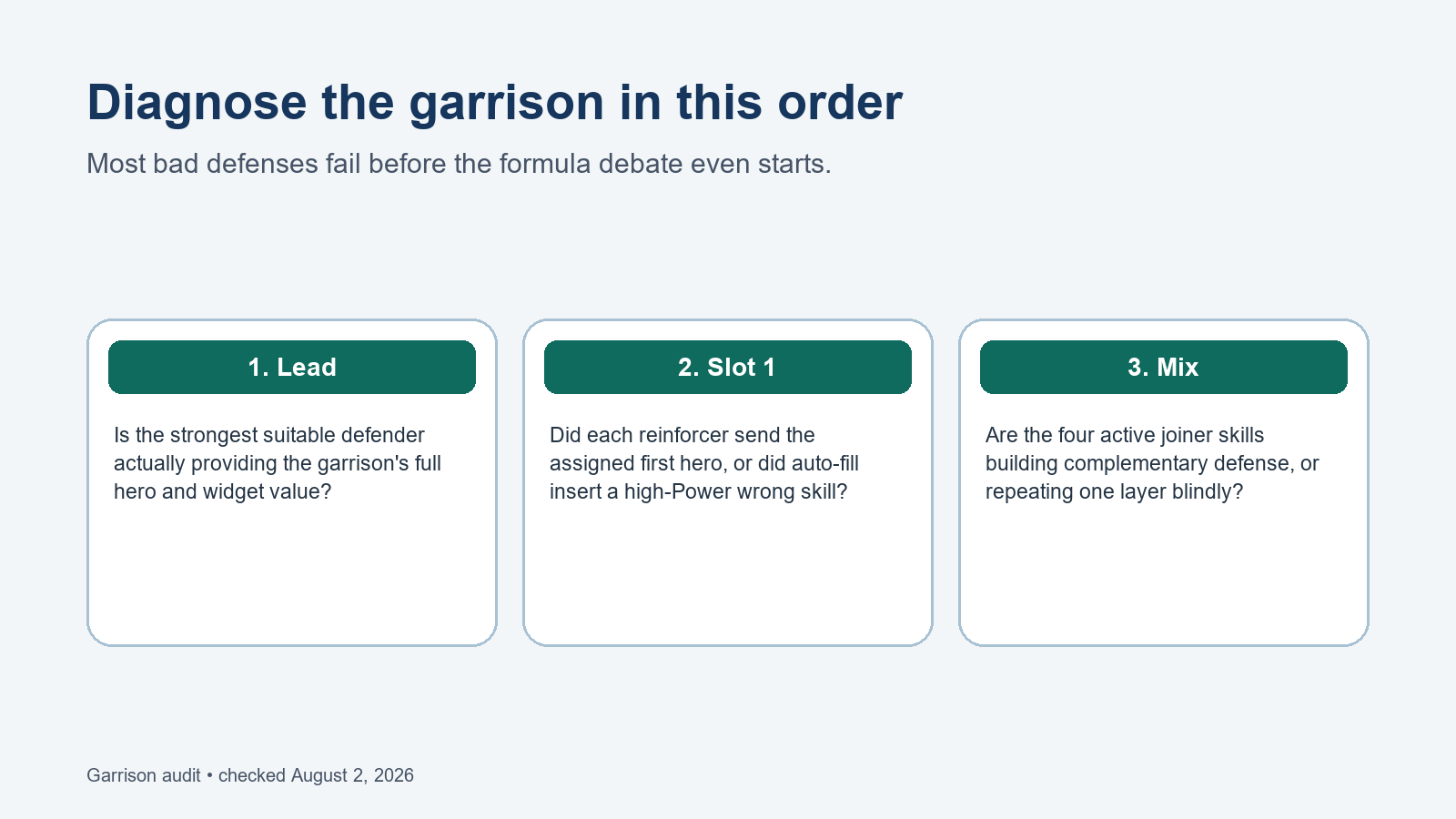
The garrison lead is the anchor. That march brings the developed heroes, gear, widget value and the complete defensive setup. Reinforcers do not become extra copies of the lead. Their first-slot choice is there to add one useful Expedition skill to the shared fight.
This distinction is why a newer legendary hero is not automatically the best reinforcement lead, and why an old Epic hero can remain important. Gordon is a Gen 1 Epic Cavalry hero, but his first Expedition skill gives total squads 25% Health. That single, reliable effect is exactly what a garrison joiner slot can use.
His second Expedition skill adds 25% total squad Attack. It matters when Gordon leads his own march, but it should not be casually counted as if every joining Gordon transfers his entire kit. The joiner decision is narrower than the hero card makes it look.
Why four Gordons can leave value on the table
Health is not a bad stat. It gives the frontline more room to survive and lets the backline keep working. The problem is that another health layer does not answer every way a garrison can lose. Defense, enemy damage reduction and role-specific defender effects can change a different part of the exchange.
Some players have compared all-Gordon stacks with mixes built around Hilde, Saul, Eric, Fahd and other joiners. The exact multipliers come from community calculations, so do not chase one magic decimal. The useful lesson is simpler: different effect categories can work better together than four identical buffs, while a poorly planned mix can still be worse than a simple stack.
Alcar changes the lead decision, not the joiner rule
Alcar is a Gen 4 Infantry defender with a kit built for holding. His Expedition skills include periodic damage reduction for Infantry and Archers, stronger Infantry damage, and a target damage-taken effect. His exclusive Expedition skill can raise Defender Squads' Health by 5–15% as the weapon grows.
That makes Alcar a serious lead candidate when he is actually developed. It does not mean an undeveloped Alcar automatically beats every older, stronger lead on every account. Lead heroes use more of their kit, so stars, widget strength and the rest of the march matter. The correct question is whether your Alcar is ready to anchor the garrison, not whether Gen 4 has appeared on the server.
The first-slot mistake ruins more garrisons than imperfect math
Check the first hero before joining a garrison. Auto-filled formations often put the highest-Power hero in front, even when its first Expedition skill does nothing useful for the defense. This small slotting mistake can waste an otherwise good reinforcement.
Build named presets instead of relying on memory: one for the assigned garrison joiner, one for offensive rallies and one for events with different rules. The second and third heroes can support march capacity, but they should not push the assigned joiner out of slot 1.
Test a mix with battle reports, not with one dramatic loss
Start from the most reliable lineup your alliance can coordinate. Run several comparable defenses, then change one joiner category rather than rebuilding the entire setup. Watch wounded trades, how long the structure holds and whether the opponent changed troop count, hero lead or rally strength.
A single report cannot prove the composition. A different enemy, capacity gap or formation can erase the effect you are trying to measure. The point of testing is to find a setup your alliance can send correctly under pressure, not to manufacture a screenshot that confirms the favorite formula.
A workable Gen 4 decision
If your members cannot coordinate several heroes, four Gordons can be a sensible baseline. If coordination is good, test a planned mix that preserves Gordon's health layer and adds another reliable defensive category. Use Alcar as the lead when his development justifies it, and treat 60:40 as a starting formation to test against the attacker—not a universal law.
The best garrison is not the one with the cleverest spreadsheet. It is the one that puts the intended lead in command, receives the intended four joiner skills and can be refilled without the plan falling apart.
Once the lead and four joiner slots are settled, compare Kingshot top-up prices on FlashMunk and buy only what the chosen breakpoint needs. Secure payment methods protect the checkout, and 24/7 customer support gives you somewhere to go if the order needs follow-up.