
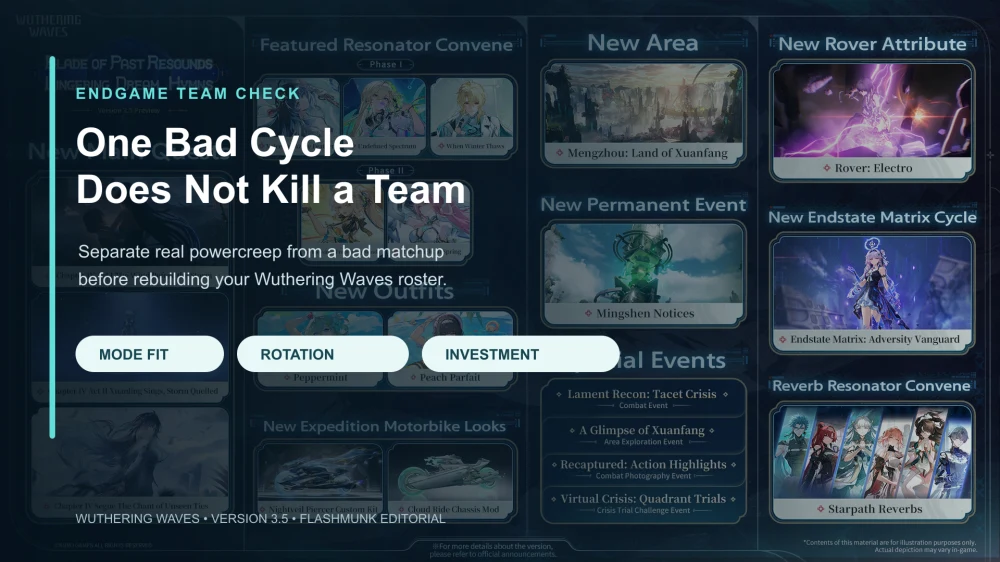
Powercreep is real. A bad matchup is also real. Treating them as the same problem is how players abandon a complete team and spend months rebuilding an answer they already had.
If an old team misses one endgame target, the only thing you know for sure is that it struggled on that stage, under those rules, with your current execution and investment. You do not yet know why.
Someone asked whether older DPS characters had fallen behind. Someone said their old units still cleared comfortably.
Someone else said newer characters hit harder, played more smoothly, resisted interruption better, and that rotating endgame rules often favor newer teams.
Both sides can be right. The useful question is not “Is this character dead?” It is “Which part of this result belongs to the character, which part belongs to the team, and which part comes from the stage?”
Three different losses get called powercreep
1. A real damage-ceiling gap
Newer damage dealers can simply have better numbers, stronger teammate synergy, or more useful damage packed into the same rotation length. If two equally built teams fight a neutral target and one repeatedly finishes with a large margin, pretending the gap does not exist helps nobody.
2. A quality-of-life gap
A newer team may gather enemies better, resist interruption, move between targets faster, or recover from a missed input without losing the whole rotation. On a spreadsheet, that can look like comfort. In a real timed challenge, comfort becomes uptime, and uptime becomes damage.
Someone also pointed out that raw damage is only part of the gap; grouping, mobility, interruption resistance, and smoother modern team synergy also change real clears.
3. The stage targets your team’s weakness
A boss-focused team can look terrible in scattered waves. A wide-area team can waste half its kit on one target. A character that relies on a specific damage type or rotation can lose far more than another team when the stage’s resistance, buff, or enemy behavior works against it.
That is not imaginary. It also does not prove the roster is obsolete. It proves this team is a bad match for that stage.
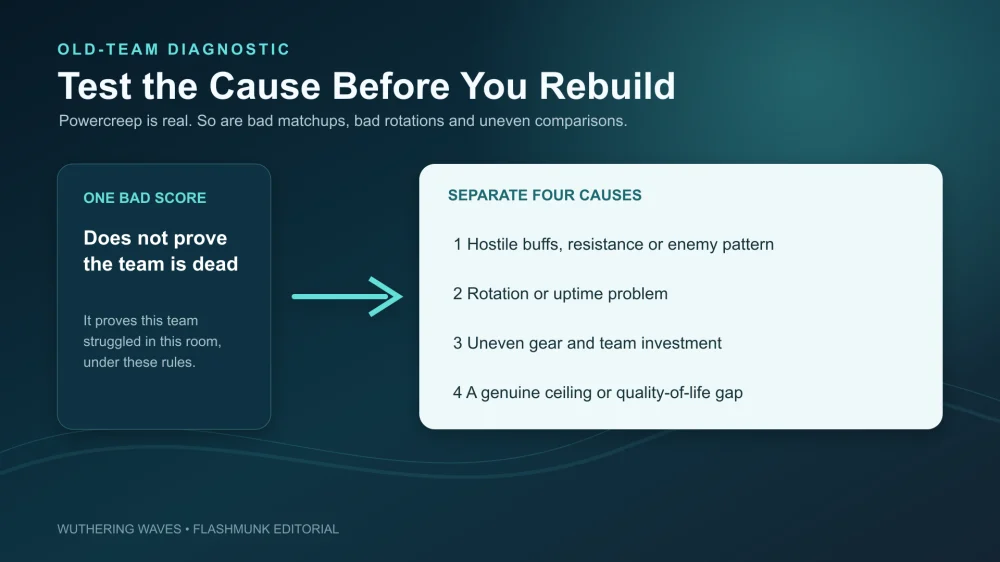
One score tells you less than players think
Endgame modes do not test every strength equally. A stage with long invulnerability windows punishes teams that need clean uninterrupted setups. Dense waves reward reach and grouping. Repeated target switches punish slow setup or weak pursuit. A roster-ordering mode can reward having several usable teams more than one perfect showcase lineup.
Version 3.2 presented Endstate Matrix as a new high-difficulty recurring challenge and also expanded Echo Management with Sonata-based plans plus sharing and importing.
The Version 3.5 announcement states that the second Endstate Matrix cycle runs from Version 3.5 through Version 3.8.
A recurring mode is supposed to keep changing the test. That makes one poor cycle useful evidence, but weak evidence. If the same team struggles across different stages, neutral matchups, and several rotations, the case becomes stronger. If it collapses only when the current rules lean against it, the case is mostly about fit.
Use a fair comparison before rebuilding
Do not compare an old team in its worst matchup with a new team on a stage built to showcase it. That comparison measures the stage as much as the roster.
Keep the reward target constant too. If the old team already earns the reward you care about, a faster clear is an upgrade in speed, not proof that the account needed rebuilding.
The key phrase is safe margin. A team does not need to match the newest speedrun to remain valuable. If it clears the content you care about with room for an imperfect dodge or a slightly slow rotation, replacing it may improve a number without improving the account.
When the old team really is falling behind
Retirement starts to make sense when the same problems survive fair testing: the team repeatedly misses neutral checks, its rotation has no realistic way to maintain uptime, its best support options are locked to another team, or a replacement solves several account problems at once instead of only adding damage.
This is where honest powercreep matters. An older character can still clear and still be a poor place for new resources. “Playable” and “worth further investment” are not the same verdict.
For example, another month of Echo tuning may buy a few seconds. A new support might fix energy, grouping, survivability, and team flexibility at the same time. In that case, the account has found a real upgrade path rather than reacting to one ugly score.
When rebuilding is the wrong response
Do not rebuild because a favored cycle made the newest team look effortless. Do not rebuild because a showcase used signature weapons and perfect execution. Do not rebuild because your old team’s clear is slower while still comfortably earning the reward you wanted.
Players often talk about a team as either meta or dead. Accounts do not work that way. A team can be worse than the newest option, excellent in two modes, awkward in a third, and still be the reason you do not need to pull another damage dealer.
So, are older Wuthering Waves teams obsolete?
Some are clearly behind the newest teams in damage, comfort, or both. That is not the same as being unusable. Judge the team across several stages, isolate the rotation and investment problems, and ask whether a replacement fixes more than the current cycle. One bad score is a clue. Repeated fair failures are a verdict.
If several fair tests show that a new character really fixes the gap, then you know what you are paying for. FlashMunk currently offers up to 23% off Wuthering Waves top-ups, with secure payment and 24/7 customer support. You lower the cost without losing a clear way to get help if the order needs attention.























The best old team is not the one you defend forever. It is the one you keep until the replacement improves the account for reasons stronger than this week’s scoreboard.